



How Many People Did Ed Gein Kill? The Verified Answer, the Suspicions, and Why the Number Still Gets Misstated
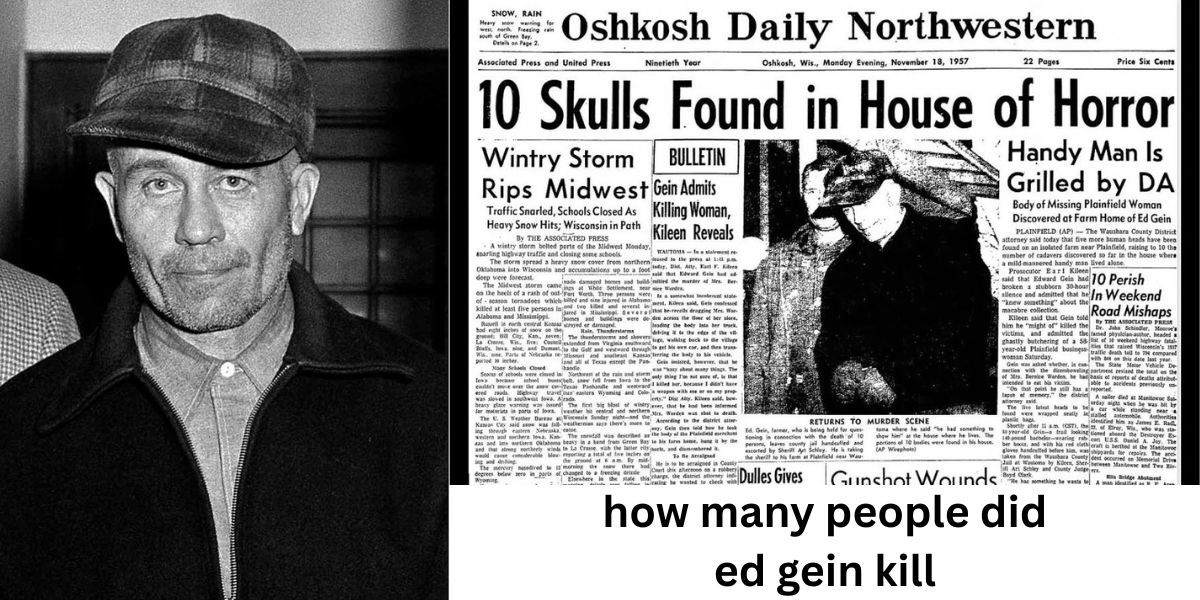
how many people did ed gein kill: If you’ve searched how many people did ed gein kill, you’ve probably noticed something frustrating: the answer is often stated with total confidence, yet the details vary from source to source. That confusion isn’t accidental. Ed Gein’s case sits at the messy intersection of confirmed homicide, self-incriminating statements, unresolved disappearances, grave desecration, and cultural mythmaking—especially after decades of films, books, and dramatizations that blur fact and fiction.
The most defensible, evidence-based answer to how many people did ed gein kill is straightforward on paper, but complicated in context. Law enforcement tied Gein to two killings by confession and strong case evidence—Mary Hogan (1954) and Bernice Worden (1957)—while other deaths and disappearances have been suspected but never proven. Reliable references typically summarize it as two confirmed murders, with additional suspected victims and a separate track of crimes involving grave robbing and corpse mutilation rather than additional homicide.
The short, verified answer: Two confirmed murders
When someone asks how many people did ed gein kill, the best-supported answer is two. Multiple reputable summaries identify Mary Hogan and Bernice Worden as the two women Gein admitted to killing, with evidence and investigative findings centered on those crimes.

The reason this answer stays “sticky” in serious sources is that it aligns with what could be anchored to a case record: a disappearance linked to Gein, corroborating physical evidence recovered during the investigation, and Gein’s own admissions. Everything beyond those two names moves from “confirmed” into “alleged,” “suspected,” or “speculated,” which matters if your goal is accuracy rather than sensationalism.
Why the case feels bigger than a two-victim count
Even with the verified answer to how many people did ed gein kill being two, many people experience Gein as a “many victims” figure because the most infamous discoveries were not just about homicide—they were about what investigators reportedly found in and around his property after Worden disappeared. The scale of those findings created a sense of horror far beyond a typical two-victim murder case, and it reshaped public perception of what “victim count” means.
Another factor is that Gein’s crimes included grave robbing and the use of human remains—acts that produce a grim inventory of body parts and objects, which can be misconstrued as evidence of a larger number of murders. In reality, a significant portion of the remains associated with the case were understood as coming from cemeteries rather than fresh killings, which is why reputable explanations separate confirmed homicide from corpse desecration.
Mary Hogan: what’s known, and what’s inferential
A careful answer to how many people did ed gein kill has to treat Mary Hogan’s case with the nuance it deserves. Hogan, a tavern owner, disappeared in 1954, and later reporting and case summaries commonly describe Gein admitting to her killing, with investigators connecting her disappearance to items recovered during the later search of his home.
At the same time, the public’s understanding of Hogan’s death is often filtered through retellings. A solid way to frame it is: Hogan is widely cited as a confirmed Gein victim in major reference-style summaries, but many granular details circulating online come from secondary narration. For SEO content that aims to be definitive, the right approach is to stick to what high-quality sources consistently support: Gein’s admission and Hogan’s status as one of the two named victims.
Bernice Worden: the crime that triggered the breakthrough
If you’re researching how many people did ed gein kill, Bernice Worden is the case that explains why Gein became internationally notorious. Worden disappeared in November 1957, and the subsequent investigation led authorities to Gein’s property and then to discoveries that transformed the case into a national story.
History-focused accounts often mark Worden as Gein’s “final victim” and emphasize the timing and investigative cascade that followed. This is the homicide most closely tied to the moment Gein was caught, which is why Worden’s name is essential in any accurate, high-authority explanation of how many people did ed gein kill—and why the case is frequently summarized around her disappearance and its aftermath.
Did Ed Gein kill anyone else? The “suspected victims” question
Many pages that answer how many people did ed gein kill also mention “suspected” victims. That language reflects a real dynamic: investigators and commentators have pointed to other deaths or disappearances as potentially connected, but suspicion is not proof, and reliable summaries remain cautious about expanding the confirmed count. One common example is speculation about whether Gein may have killed his brother, whose death was ruled accidental even though later commentators questioned it.
This is also where pop culture creates inflation. Dramatizations may depict additional murders for narrative weight, but “shown on screen” is not “supported by evidence.” Modern coverage of dramatizations has explicitly highlighted fabricated or exaggerated storylines and the need to distinguish entertainment from what is actually documented about Gein.
The difference between “confirmed,” “confessed,” and “convicted”
A high-quality answer to how many people did ed gein kill should separate three categories that casual retellings blur. “Confirmed” generally means supported by strong evidence and consistent sourcing; “confessed” means the suspect admitted it; “convicted” means a court found guilt under criminal procedure and evidentiary rules. Gein’s legal path complicates the neatness of that last category because his case involved findings related to mental competence and criminal responsibility.
Britannica’s biography treatment, for example, notes that Gein was found guilty of murdering a woman and also confessed to another killing, which aligns with the two-victim framework while also hinting at why people get tangled in the “convicted vs. confessed” issue. The clean SEO takeaway is this: the best-supported response to how many people did ed gein kill is about the homicide total linked to him, not a simplistic “how many convictions.”
Why the grave robbing matters in the victim-count conversation
The reason the query how many people did ed gein kill keeps resurfacing is that Gein’s crimes are remembered as “more than murder.” Investigators and subsequent summaries describe Gein as a body snatcher and grave robber who took remains from local cemeteries, which created a shocking volume of human material associated with the case.
From a clarity standpoint, it helps to say it plainly: grave robbing generates victims in a moral and emotional sense—families, communities, the dignity of the deceased—but it does not automatically raise the homicide count. That distinction is the core reason authoritative sources can state “two murders” while also describing a much wider constellation of harm.
A practical evidence table: what’s solid vs. what’s speculation
Below is a structured way to interpret how many people did ed gein kill without getting trapped by rumor loops or dramatized narratives.
| Category | What it means | Names commonly included | Confidence level for homicide count | Why it’s treated this way |
|---|---|---|---|---|
| Confirmed murders | Cases consistently supported by major references as killings attributed to Gein | Mary Hogan; Bernice Worden | High | These are the two women most reliably tied to Gein by admissions and case summaries |
| Suspected additional killings | Deaths sometimes linked via speculation, not proof | Often his brother’s death is discussed | Low to uncertain | Speculation exists, but official rulings and lack of proof keep them outside the confirmed count |
| Non-homicide remains (grave desecration) | Human remains obtained from graves rather than murder | Multiple exhumed bodies (not “killed” by Gein) | Not applicable | These acts are central to the case’s horror, but do not equal additional killings |
| Pop-culture additions | Extra murders depicted for storytelling | Varies by film/series | Not reliable | Dramatizations may invent victims or events that have no evidentiary basis |
The single sentence that answers the query correctly
If your goal is to answer the query how many people did ed gein kill in one line—accurately, responsibly, and in a way that won’t collapse under scrutiny—this is the best formulation: Ed Gein is most reliably linked to two killings (Mary Hogan and Bernice Worden), with other deaths sometimes suspected but not proven.
That wording matters because it avoids the two most common content pitfalls: pretending suspicion is certainty, or reducing the case to a sterile number while ignoring why people are asking in the first place. A definitive resource respects both: it gives the number, and it explains the boundary between evidence and legend.
A short quote that captures how the legal process evolved
One under-discussed reason the public keeps re-asking how many people did ed gein kill is that Gein’s trial timeline was not linear, and “what happened in court” doesn’t map neatly onto “what happened in the crimes.” In later proceedings, summaries note that doctors determined he was “mentally able to confer with counsel and participate in his defense.”
That quote matters because it signals why there can be distance between public certainty and courtroom resolution. When competency and mental health findings shape a case, the public’s “answer” often migrates toward simplified storytelling—exactly the environment where victim counts get distorted.
Common misconceptions that inflate the number
A frequent misconception in content answering how many people did ed gein kill is that the presence of multiple human remains implies multiple murders. In Gein’s case, major references emphasize that he robbed graves and used body parts taken from cemeteries, which can create a mistaken impression that he killed everyone represented by those remains.
Another misconception comes from genre blending. Because Gein influenced horror archetypes—some sources note his cultural impact on famous fictional killers—the story is often retold in a way that borrows traits from other murderers (serial-killer “sprees,” long victim lists, cross-state patterns) that don’t align with what’s actually documented about Gein’s known homicide total.
Why search intent around this question is so intense
People don’t only search how many people did ed gein kill for trivia. They search because the case is a landmark in the public imagination: it surfaces questions about how we define violence, how communities process fear, and how media turns real suffering into mythology. A strong article meets that intent by treating the victims as real people, not mere data points, and by refusing to “round up” a number for dramatic effect.
There’s also a modern layer: contemporary streaming dramatizations renew interest and can re-seed inaccuracies at scale. Responsible explainers now explicitly point out when shows invent events, which is a useful reminder for anyone writing or reading about Gein today.
Conclusion: The best answer, stated clearly and responsibly
So, how many people did ed gein kill? The most credible answer is two—Mary Hogan and Bernice Worden—while additional deaths have been suspected but remain unproven.
If you want your understanding to be resilient—something you can cite, publish, and stand behind—anchor your conclusion to what high-quality references consistently support, and treat everything else as what it is: uncertainty, speculation, or dramatized fiction.
FAQ
Why do some websites claim a higher number than two?
Many inflated answers to how many people did ed gein kill come from mixing confirmed homicide with his grave-robbing crimes or from dramatizations that add fictional victims.
Was Ed Gein ever linked to other deaths besides Hogan and Worden?
Discussions about how many people did ed gein kill sometimes include speculation about other deaths (such as his brother), but those claims are not proven at the level needed to expand the confirmed homicide count.
Did grave robbing increase how many people Ed Gein killed?
No—grave robbing is a separate category of crime, and it doesn’t change the homicide answer to how many people did ed gein kill, even though it massively expanded the harm and shock of the case.
What’s the most accurate one-sentence answer to this question?
If you need a publication-safe line for how many people did ed gein kill, use: “Ed Gein is most reliably linked to two killings—Mary Hogan and Bernice Worden—with other deaths sometimes suspected but not proven.”